
Key Takeaways
- A China-to-USA shipping agent should coordinate supplier pickup, warehouse receiving, consolidation, export documents, booking, and loading milestones, with customs-facing steps and delivery handled by qualified North American partners.
- Door-to-door service is not automatically DDP, so duty, tax, customs, and delivery responsibilities must be confirmed in writing for each shipment.
- Gateway and mode choices depend on the China origin, US destination ZIP code, cargo profile, carrier conditions, and season, and must be confirmed in writing.
- Rey Logistics does not act as a licensed US or Canadian customs broker; importers should confirm which qualified party handles customs-facing work.
- A complete quotation request includes the China origin, final ZIP or postal code, commodity, cartons, gross weight, dimensions, cargo-ready date, Incoterm, and special handling details.
- Final delivery planning should address appointment booking, unloading capability, access restrictions, and detention or waiting-time responsibility.
A shipping agent from China to the USA should cover the full chain from supplier pickup in China through booking, export documentation, consolidation, and loading, then hand off to qualified North American partners for customs-facing steps and destination delivery. For importers, the practical test is whether the agent can document each milestone in writing and name the party responsible for every handoff. Because carrier schedules, port pairs, cutoffs, and transit times change, every route and service scope needs current written confirmation before you confirm a shipment plan.
Direct route overview for China-origin cargo moving to the United States
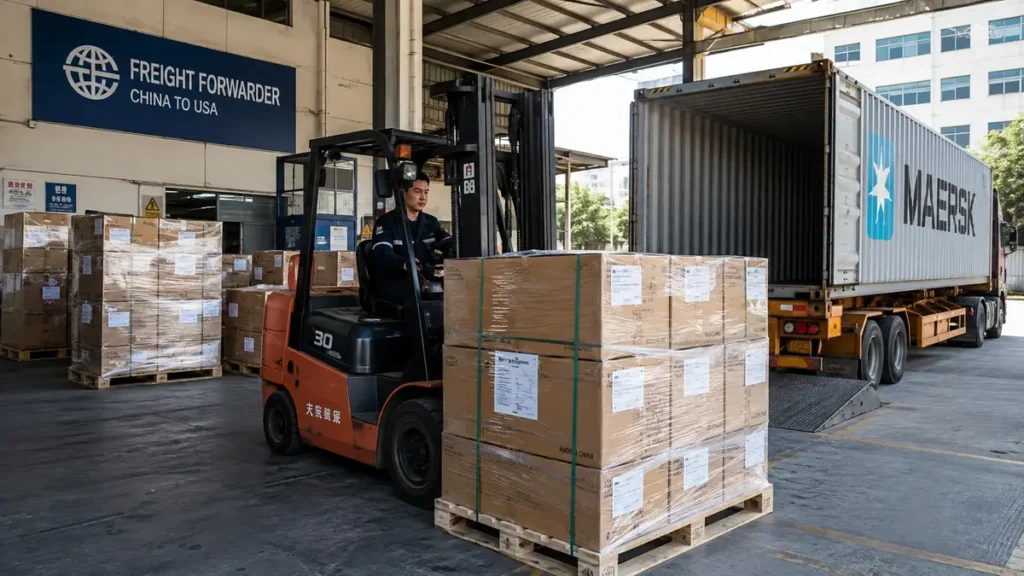
There is no single “shipping agent service” definition that fits every China-to-USA lane. The origin city or province, the chosen China port or airport, the US gateway, and the final ZIP code together determine which combination of ocean freight, air freight, rail, and truck legs is realistic. A competent agent starts by mapping those four points rather than quoting a generic lane.
For most commercial cargo, the planning conversation begins with mode. Ocean freight, whether FCL or LCL, is typically evaluated when the cargo is not time-critical and the carton volume justifies port-to-port handling. Air freight is evaluated when speed matters more than unit cost. Rail and truck combinations may enter the discussion for inland US destinations, but the specific routings and handoffs depend on carrier networks, port conditions, season, and the receiving location.
Door-to-door arrangements can streamline coordination, but door-to-door is not automatically DDP. Under DDP the seller bears duties and taxes and the customs process, which is a commercial and legal arrangement that must be confirmed in writing for each shipment. Many importers are better served by a clearly scoped service where the agent coordinates China-origin work and destination partners handle customs-facing steps. Rey Logistics coordinates customs-facing handoffs and destination delivery through qualified North American partners and does not act as a licensed US or Canadian customs broker.
Mexico enquiries sit outside the approved public USA/Canada route dataset and require manual review, so do not assume a US plan automatically extends south of the border.
China origin ports, airports, and supplier-pickup considerations
China-origin support typically includes supplier pickup, warehouse receiving, cargo consolidation, export-document coordination, booking, and loading milestones. Which of these you need depends on whether you buy from one factory or several, whether suppliers can deliver to a warehouse, and whether the cargo is ready on your intended cargo-ready date.
Port and airport selection
China has multiple major ocean gateways and air cargo airports, and the right one depends on where your suppliers are, the service options your carrier or consolidator offers, and the US gateway you want. Do not assume the nearest port produces the best plan; inland haulage, feeder options, and sailing frequency all affect the practical choice. Ask the agent to explain why a specific origin port or airport was selected for your cargo and to confirm current service availability in writing.
Supplier pickup and consolidation
Supplier pickup needs a precise address, contact, pickup window, and cargo-ready date. If multiple suppliers are involved, consolidation at a China warehouse can reduce handling complexity, but it also adds receiving, labeling, and re-palletizing steps that should be priced and scheduled. Confirm who inspects carton counts and condition at receiving, how discrepancies are documented, and whether photos or receiving reports are provided.
Export documentation and booking
Export-document coordination usually covers the commercial invoice, packing list, and booking instructions, with other documents handled by the parties qualified to issue or verify them. The agent should tell you which documents it prepares, which the supplier must provide, and which a licensed broker or other qualified party must review. Never assume an agent handles customs classification, duty determination, or regulatory compliance questions; those require qualified parties.
USA gateway choices and when all-water, air, or rail combinations may fit
US gateway choice is a trade-off among ocean or air entry point, inland distance to the final ZIP code, carrier service options, and the importer’s tolerance for handoffs. All-water service means the cargo moves by ocean to a US port and then onward to the destination; it can suit importers whose receiver is near a coastal port or who prefer to arrange inland moves separately. Air service suits cargo where speed is the priority, but airport handling, truck transfer, and cutoff discipline still apply.
Rail and truck combinations may fit when the US gateway is coastal but the receiver is inland. These routings involve multiple parties and transfer points, so the agent should describe each handoff, who is responsible, and what visibility exists at each stage. Because schedules, port conditions, and carrier networks shift, the specific combination must be confirmed for your shipment rather than assumed from a previous move.
| Option | Typical fit | What to confirm in writing |
|---|---|---|
| Ocean FCL | Larger carton counts moving to one receiver | Origin port, US gateway, container type, loading window, carrier booking confirmation |
| Ocean LCL | Smaller volumes that do not justify a container | Consolidation warehouse, co-loading terms, destination handling, delivery scope |
| Air freight | Time-sensitive cargo; airport-to-airport or with delivery | Origin and destination airports, cutoff, chargeable weight basis, delivery appointment |
| Rail or truck combination | Inland US receivers reached via a coastal gateway | Each handoff, responsible party, tracking visibility, appointment and unloading terms |
This table is a planning aid, not a rate or schedule quote. Each row depends on carrier availability, cargo characteristics, season, and destination, so require current written confirmation before you commit.
Final ZIP or postal-code delivery, appointments, unloading, and importer responsibilities
Destination planning starts with the exact final ZIP or Canadian postal code, not a city name. Access restrictions, residential versus commercial delivery, dock availability, liftgate needs, and appointment requirements all change the delivery scope and should be disclosed early. If the receiver cannot unload a trailer or container, that must be known before the plan is fixed.
The importer remains responsible for customs-facing obligations unless a written arrangement assigns them to another party. That includes making sure a qualified customs broker is engaged, that entries are filed correctly, and that duties, taxes, and fees are paid under the agreed terms. Rey Logistics does not provide customs-brokerage services itself. If your purchase terms are DDP, confirm in writing which party bears duties and taxes, how the customs process is handled, and what documentation the importer still must supply.
Delivery appointment and unloading terms should be agreed in advance. Confirm who books the appointment, what happens if the receiver misses it, whether detention or waiting time applies, and who pays if it does. These items vary by carrier and destination and cannot be assumed.
Route-comparison checklist before confirming a shipment plan
Before confirming any plan, assemble the facts a quotation needs and compare options on a like-for-like basis. A useful quotation needs the China origin, final US ZIP or Canadian postal code, commodity, cartons, gross weight, dimensions, cargo-ready date, Incoterm, and any special handling details. Missing any of these usually produces an incomplete answer.
- Origin scope: Is supplier pickup included, and is consolidation needed?
- Mode and gateway: Why was this origin port or airport and US gateway chosen?
- Milestones: Which booking, loading, departure, and arrival updates will you receive?
- Handoffs: Which parties handle customs-facing steps, rail, truck, and final delivery?
- Incoterm: Who pays freight, duties, taxes, and destination charges under your terms?
- Delivery: Appointment, unloading, access, and detention terms confirmed in writing?
- Exceptions: How are delays, damage, or discrepancies documented and escalated?
Finally, ask what remains unconfirmed. A reliable agent will separate what is booked and documented from what still depends on carrier confirmation. Never treat a verbal estimate of rate, transit time, capacity, or delivery date as a commitment.
Frequently Asked Questions
Does a China-to-USA shipping agent handle customs clearance?
A shipping agent may coordinate the handoff to a customs broker, but customs-facing work must be performed by qualified parties. Rey Logistics coordinates these handoffs through qualified North American partners and is not a licensed US or Canadian customs broker. Confirm in writing which party files entries, pays duties and taxes, and responds to customs inquiries.
Is door-to-door shipping from China automatically DDP?
No. Door-to-door describes the physical scope of movement, while DDP is a commercial term assigning duties, taxes, and customs responsibility to the seller. The two can be combined, but only if the written arrangement says so. Confirm who bears each cost and obligation before the cargo ships.
What information does a shipping agent need to quote a China-to-USA shipment?
Provide the China origin, final US ZIP or Canadian postal code, commodity, carton count, gross weight, dimensions, cargo-ready date, Incoterm, and any special handling needs. Extra details such as supplier contacts or appointment restrictions help refine the plan. Without these facts, any quote is likely to be incomplete or revised later.
Can I combine cargo from several Chinese suppliers into one shipment?
Consolidation at a China warehouse can combine multiple suppliers into one booking, which may simplify documentation and destination handling. It also adds receiving, labeling, and scheduling steps that need pricing and clear responsibility. Ask how carton counts, condition, and discrepancies are documented at receiving.
Does Rey Logistics cover Mexico routes as part of the USA plan?
No. Mexico enquiries require manual review and are not part of the approved public USA/Canada route dataset. If your destination is in Mexico, raise it separately rather than assuming a US shipment plan extends there. A US or Canadian destination should be stated with the exact ZIP or postal code.